0:03
News Story
Dominion regulator recommends rejection of utility’s long-term plan
Utility says point of contention represents about ‘5%’ of entire Integrated Resource Plan
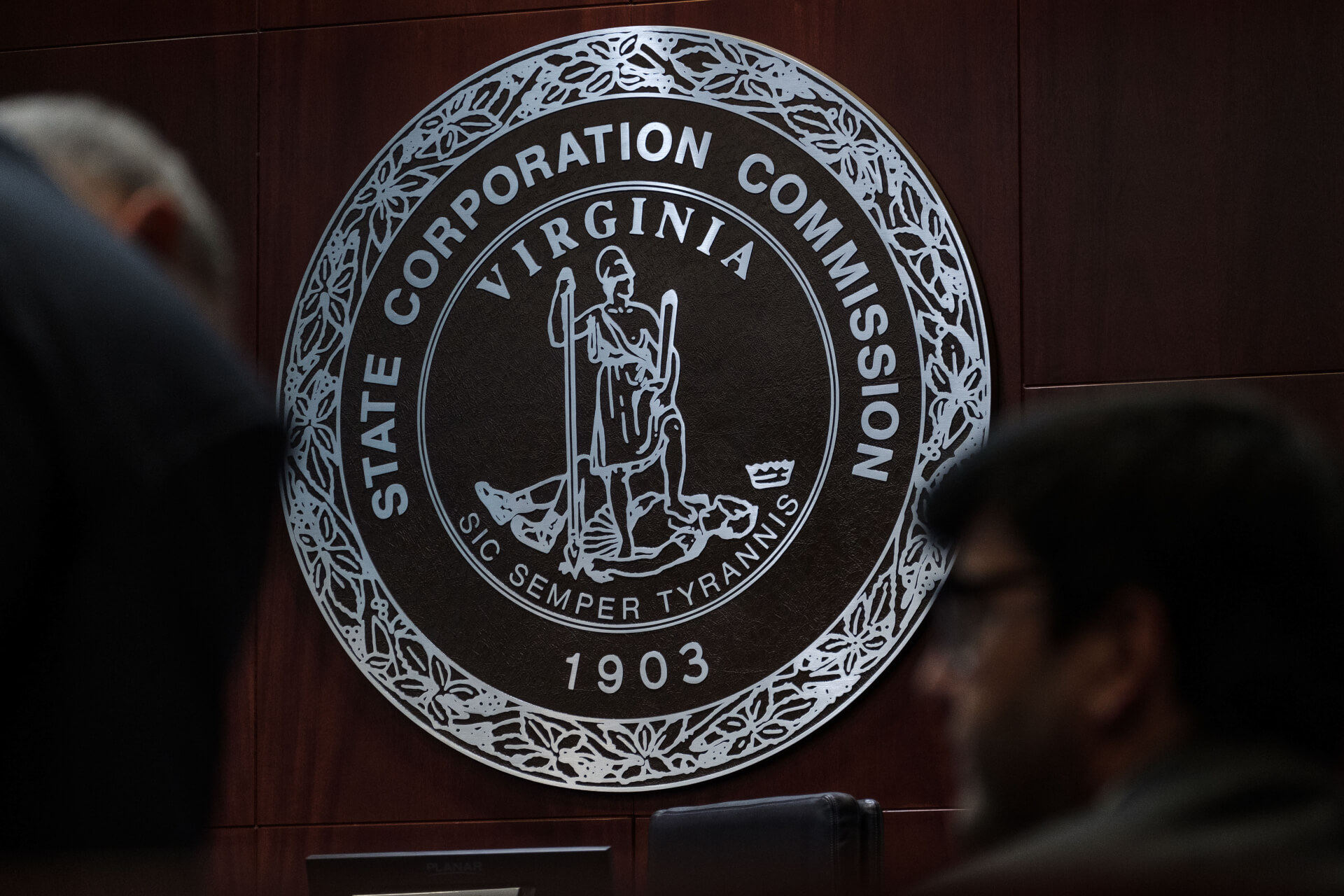
The State Corporation Commission regulates Virginia electric utilities. (Ned Oliver/ Virginia Mercury)
A utility regulator with the State Corporation Commission is recommending the body reject Dominion Energy’s most recent long-term plan because of its inclusion of new natural gas plants.
In her Friday recommendation, which will now go to the three-member SCC for a final decision, Hearing Examiner Ann Berkebile wrote that Dominion’s Integrated Resource Plan is neither “reasonable” nor “in the public interest.”
The IRP is a non-binding, long-term planning document that outlines future investments Dominion plans to make over the next 15 to 25 years to meet future electricity demands. Because of a projected increase in data center development in Northern Virginia, as well as expected upticks in electric vehicle use, Dominion’s plans call for the addition of four natural gas combustion turbines to provide energy that can be quickly turned on during times of peak demand.
Berkebile noted that the 2020 Virginia Clean Economy Act, which requires decarbonization of the grid by 2050, states that if Dominion wants a new carbon-emitting generation source, it must prove that energy conservation goals have been met and that building new sources of generation is more affordable than relying on other solutions.
Berkebile said Dominion had not met those requirements.
“The 2023 IRP lacks information reflecting that Dominion has fully considered all in-state and regional resources as an alternative to the [combustion turbines],” she wrote. “In fact, the company acknowledged it has not yet conducted an evaluation to determine if there could be third-party alternatives to the CTs, even though it already intends to file” an application to build a peaker plant in Chesterfield County.
While Dominion said it disagrees with the hearing examiner’s conclusion about new natural gas power, it noted that Berkebile found the “vast majority” of the IRP is reasonable and in the public interest.
“About 95% of all power generation [in the IRP] is carbon free,” said Dominion spokesperson Aaron Ruby. “The only point of contention is 5% or less coming from natural gas.”
The state’s largest electric utility also pointed to Berkebile’s acknowledgment that the Virginia Clean Economy Act only requires Dominion to prove new gas sources are better alternatives when it files for permission to build specific projects.
“We are fully committed to meeting all the requirements of the VCEA. We believe that this IRP does that,” said Ruby. “You’ll see all renewable development plans in the IRP meet and exceed requirements of VCEA.”
Berkebile’s recommendation isn’t unprecedented. In 2018 and 2021, the SCC rejected the utility’s plans, saying it hadn’t outlined “least cost” ways of meeting demand.
The hearing examiner’s recommendation should give Dominion “pause as they are considering new gas resources,” said Will Reisinger, an attorney for Clean Virginia, a group created by Charlottesville millionaire Michael Bills to counter Dominion’s influence in the General Assembly that advocates for renewables adoption.
“The hearing examiner applied the plain language of the statute, which expressed a presumption against new fossil fuel facilities,” Reisinger said.
Chesapeake Climate Action Network Virginia Director Victoria Higgins said Berkebile’s report “corroborates what the environmental community and residents around the proposed methane gas plant in Chesterfield have been saying all along: there is no evidence to suggest that Dominion must build new fossil fuel plants to meet demand.”
In November, the group released a report saying that an alternative plan to meet demand using renewable sources rather than the peaker plant would save ratepayers $28 billion and avoid 52 million tons of greenhouse gas emissions.
Among other recommendations, Berkebile said that in future IRPs, Dominion should include an analysis of the costs of Virginia staying in or leaving the carbon market called the Regional Greenhouse Gas Initiative. A Democratic-led General Assembly joined Virginia with the market in 2020, a move Republican Gov. Glenn Youngkin has sought to reverse.
Berkebile also suggested including a third-party analysis to verify forecasts of load increases resulting from data centers, and recommended that the SCC set up guidelines for involving other parties in future IRP proceedings, a requirement of 2023 legislation.
Walton Shepherd, Virginia policy director for the Natural Resources Defence Council, said that the stakeholder group could result in a document with plans that actually come to fruition.
“Forcing them to the table does create a chance to have a more realistic document that we can all work from as we all move into a lower carbon future,” Shepherd said.
The hearing examiner’s recommendation will be given to the SCC judges, who will make a final ruling on the IRP.
GET THE MORNING HEADLINES.

Our stories may be republished online or in print under Creative Commons license CC BY-NC-ND 4.0. We ask that you edit only for style or to shorten, provide proper attribution and link to our website. AP and Getty images may not be republished. Please see our republishing guidelines for use of any other photos and graphics.

Related News